SEND Reforms 2026: A Response from Pupil Pathways
How our inclusive transition platform aligns with Every Child
Achieving and Thriving and SEND Reform: Putting Children and
Young People First and what it means for schools, local authorities,
and MATs.
Executive Summary
Pupil Pathways is uniquely positioned to support the Department for Education’s future vision for SEND, as outlined in Every Child Achieving and Thriving and SEND Reform: Putting Children and Young People First. Government reforms emphasise early identification, inclusive mainstream provision, multiagency collaboration, data-driven decision-making, and strengthening transitions across all educational phases.
Pupil Pathways aligns directly with these priorities by offering a unified digital ecosystem that enables schools, trusts, early years settings and local authorities to securely share information, act early, and deliver consistent support across a learner’s entire journey.
Our modules, SixIntoSeven, StepIntoSchool, Foresight, and NextSteps, enable consistent pupil-level information to follow the child, support early flags for emerging needs, streamline the creation of Individual Support Plans, and improve coordination between schools, health services, and local authority inclusion teams.
1 in 5
Children missing a day of school every fortnight
20m
More school days attended per year by 2028/29
2028
National Inclusion Standards in place across all schools
See how Pupil Pathways supports SEND transitions
Book a demo to explore how our platform aligns with the 2026 SEND reforms in your local authority or trust.
Contents
| Reform Priority | Pupil Pathways Module | How It Supports |
|---|---|---|
| Early identification of SEND | StepIntoSchool, SixIntoSeven | Transfers SEND indicators, attendance, and safeguarding concerns months before a child starts a new phase |
| National Inclusion Standards | All modules | Standardised templates for collecting, organising, and interpreting pupil information across entire trusts and LAs |
| Individual Support Plans (ISPs) | Foresight, SixIntoSeven | Structured digital mechanism for building ISPs from existing transition data, with multiagency input |
| Experts at Hand service | Foresight | Shared digital environment for professionals to collaborate, share assessments, and review progress |
| Mainstream inclusion | SixIntoSeven, StepIntoSchool | Early transfer of SEND profiles prevents the "reset" effect and enables proactive planning |
| Attendance improvement | Foresight | Identifies dropping attendance patterns and persistent-absence risks across school populations |
| Post-16 transitions | NextSteps | Securely shares SEND information, ISPs, and learner profiles with FE colleges and sixth forms |
Aligned with Reform Priorities
Introduction
The SEND system in England is undergoing its most significant transformation in a decade, driven by the government’s ambition to build a more inclusive, equitable, and responsive education system. Both Every Child Achieving and Thriving (2026) and SEND Reform: Putting Children and Young People First (2026) outline reforms that depend on the system’s ability to identify needs early, share information reliably, provide high-quality universal and targeted support, and ensure children can succeed in mainstream settings wherever possible.
“Standards and inclusion together, working hand-in-hand, are how we can transform opportunities and outcomes.”
— Every Child Achieving and Thriving, 2026
The white paper recognises challenges that include late identification, inconsistent local practice, and families needing to “fight for support”, resulting in inequitable experiences across the country. The SEND Reform consultation expands on this by proposing a universal offer with clear expectations for early support, an improved role for multiagency teams, and a streamlined mechanism to ensure commonly occurring needs can be consistently met in mainstream education.
Pupil Pathways, a secure digital transition and inclusion platform used by schools and local authorities, offers a practical infrastructure aligned with these reforms. The platform ensures early, structured, and consistent information-sharing across phases. Its core design principle is simple: early information enables early intervention.
This report examines how Pupil Pathways supports and enhances the government’s SEND ambitions, first through alignment with reform priorities, then through the specific capabilities of each platform module.
Early Identification
Government SEND reforms place early identification at the centre of system improvement. The SEND Reform consultation states unequivocally:
“Children and families should receive the support they need as soon as possible, with a quick response to changing needs.”
— SEND Reform: Putting Children and Young People First, 2026
This highlights the system’s longstanding issue: identifying emerging needs too late and relying on reactive intervention rather than proactive support. Every Child Achieving and Thriving emphasises the importance of rebuilding systems around children so that support is delivered at the earliest point where it can have maximum impact.
Pupil Pathways directly addresses this priority through its core design principle: early information enables early intervention. The platform’s transition modules (StepIntoSchool, SixIntoSeven) ensure that information on SEND indicators, attendance, safeguarding concerns, learning needs, and prior interventions is transferred months before a child begins a new phase. This anticipatory data allows receiving settings to plan provision, deploy staff expertise, and adjust timetables or environments before issues escalate.
Furthermore, Pupil Pathways captures nuanced contextual information, not just statutory categories, such as communication development, sensory profiles, co-occurring vulnerabilities, and pupil voice. This depth of early data operationalises early identification at scale, making it both systematic and consistent across schools, trusts, and local authorities.
National Inclusion Standards
The government’s proposed National Inclusion Standards aim to ensure that all schools provide a consistent baseline of support for children with SEND. The consultation highlights that too many families currently experience a “postcode lottery”, where the support available depends heavily on the local authority, school capacity, or access to specialist provision. National standards are intended to reduce this variability by clearly defining what inclusive provision should look like in every mainstream setting.
“A clear and consistent baseline of support will ensure that children and young people receive the help they need without unnecessary delay.”
— SEND Reform: Putting Children and Young People First, 2026
Pupil Pathways supports the implementation of these standards by providing structured digital templates for collecting, organising, and sharing pupil information across schools, trusts, and local authorities. By standardising how key information is captured during transition points, the platform helps ensure that receiving settings have a consistent understanding of each learner’s needs before the first day of a new phase.
These shared templates allow schools to record academic, pastoral, safeguarding, and SEND information in a consistent format, reducing ambiguity and improving the quality of communication between professionals. This structured approach ensures that information is not lost between settings and that support strategies can continue seamlessly.
At scale, this enables trusts and local authorities to build a coherent picture of inclusion across entire cohorts, allowing leaders to identify patterns, allocate resources effectively, and ensure that the expectations of National Inclusion Standards are implemented consistently across their education system.
Individual Support Plans (ISPs)
SEND Reform introduces a major shift: Individual Support Plans becoming statutory for all pupils receiving Targeted or Specialist support. The consultation states that an ISP will “describe the child’s day-to-day educational provision and the support required, and will be created collaboratively with parents”. ISPs represent a more flexible, responsive mechanism than EHCPs and aim to ensure consistent support across schools and phases.
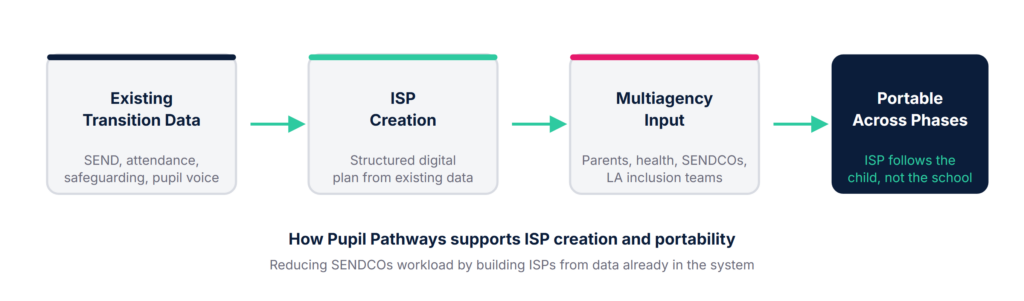
Pupil Pathways supports ISP implementation by providing a structured, digital mechanism for capturing needs, interventions, progress, and parental input. The platform already functions as a comprehensive record of a child’s educational profile, enabling schools to build an ISP directly from existing data: learning needs, risk indicators, attendance patterns, safeguarding information, prior interventions, and pupil voice.
The ISP portability challenge
If every school uses its own formats or criteria, the government’s ambition for national coherence collapses. Pupil Pathways provides a unified structure that ensures ISPs look and feel the same across settings, improving portability as learners transition across phases. This also reduces workload for SENDCOs, who otherwise must repeatedly rewrite plans for each transfer.
The platform’s multiagency collaboration features support the requirement that ISPs be created with input from families and relevant specialists. Digital collaboration removes barriers such as scheduling challenges and ensures transparency. Pupil Pathways provides the infrastructure needed to scale ISPs nationally.
Multiagency Coordination and "Experts at Hand"
One of the most transformative aspects of SEND Reform is the introduction of the Experts at Hand service: a coordinated multiagency workforce providing earlier access to speech and language therapists, educational psychologists, and health professionals.
“Quicker access to health professionals… to get support to children early.”
— SEND Reform: Putting Children and Young People First, 2026
Pupil Pathways enables this vision by providing a shared digital environment where multiple professionals can collaborate in real time. The Foresight system, used by schools and local authority inclusion teams, allows professionals to open cases, share assessments, record interventions, and review progress collectively.
The platform’s secure data-sharing supports coordinated support planning which is a major challenge cited by local authorities due to inconsistent processes. Pupil Pathways’ use of MIS integration and GDPR-compliant data flows ensures that all agencies can access the same accurate information, preventing fragmentation. Because the platform collects and transfers data early, especially during transitions, it allows specialists to plan support before needs escalate.
Inclusion in Mainstream Education
“Children with special educational needs and disabilities must be able to attend their local mainstream school and have their needs met by highly trained teachers, leaders and support staff.”
— Every Child Achieving and Thriving, 2026
This ambition reflects a shift away from overreliance on specialist places and towards building mainstream capacity, consistency, and confidence. To achieve this, mainstream schools must know a learner well before they arrive, be able to plan adaptations, and access a full picture of the child’s strengths, needs and history.
This is exactly what Pupil Pathways delivers. The platform ensures early transfer of SEND profiles, prior interventions, risk indicators, attendance patterns, safeguarding notes, and pupil voice. It prevents the “reset” effect seen when learners transfer schools: progress is not lost, interventions don’t restart from scratch, and new staff understand the learner from day one.
This strengthens mainstream inclusion and helps prevent escalation to specialist placements due to poor early planning. Pupil Pathways acts as a practical mechanism for delivering the inclusive mainstream system envisioned in the reforms.
Attendance, Engagement, and Early Warning Systems
Attendance and engagement are central to the government’s reform agenda. The white paper highlights the scale of the challenge:
“Around one in five children are missing a day of school every fortnight.”
— Every Child Achieving and Thriving, 2026
The government commits to supporting schools so that children attend 20 million more days per year by 2028/29, representing the fastest improvement in a decade. Attendance is also identified as an early indicator of unmet need, mental health concerns, or SEND barriers.
Pupil Pathways’ Foresight inclusion-tracking system allows schools and local authorities to identify children with dropping attendance patterns, persistent-absence risks, or fluctuating engagement. It provides progress tracking of all cases, allowing regular reviews between a multidisciplinary team.
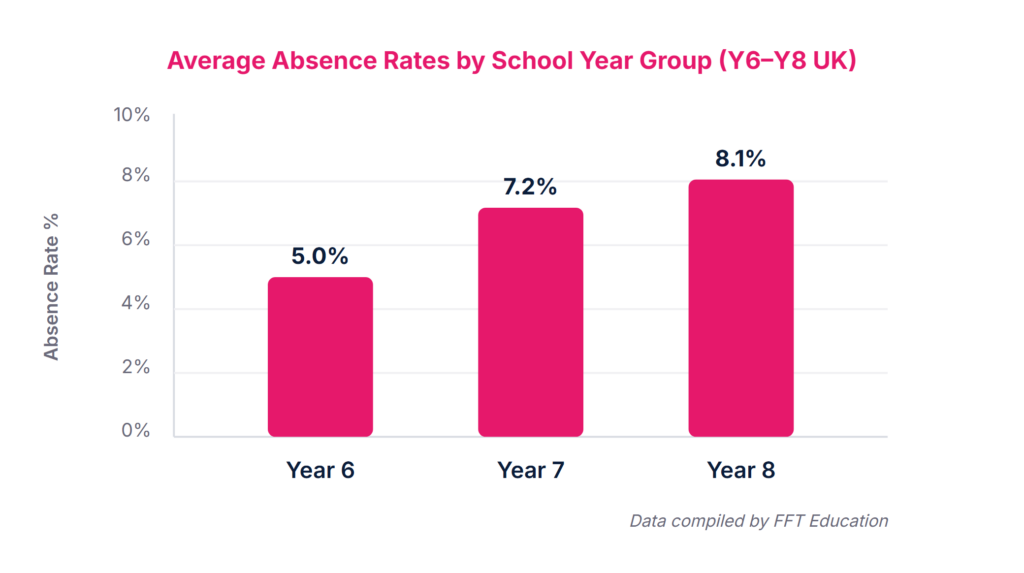
Transition modules also play a crucial role. When secondary schools have early access to attendance patterns from primary schools, they can proactively support learners before patterns worsen. Multiagency collaboration features reduce fragmentation between safeguarding teams, attendance officers, SENDCOs, and external professionals. By identifying risks earlier, ensuring continuity of support, and enabling cross-agency review, Pupil Pathways becomes a key mechanism for achieving the attendance-improvement commitments set out in the reforms.
Curriculum Access, Adaptive Teaching & Removing Barriers
The reforms emphasise that mainstream settings must embed adaptive teaching and ensure children can access a broad curriculum. High-quality teaching must be at the heart of the school system, a point that is particularly significant for learners with SEND, whose progress often stalls when teachers lack the right information to plan appropriately.
Pupil Pathways strengthens adaptive teaching by ensuring teachers receive detailed profiles of learner needs before their first lesson. Transition modules share structured data on cognition and learning, speech and language development, sensory needs, emotional regulation, previous adaptations, and successful strategies.
What proactive adaptive teaching looks like
When a Year 7 teacher knows in advance which pupils use coloured overlays, have working-memory difficulties, rely on chunking, or need reduced copying from the board, adaptive teaching becomes proactive, not reactive. Prior knowledge, adaptive strategies, and evidence-based provision combine into a unified framework that operationalises the reforms’ ambitions for SEND-inclusive teaching.
Data-Driven Decision Making & Accountability
Local authorities benefit from aggregated cohort data, enabling them to identify trends in SEND prevalence, transition challenges, attendance patterns, or inclusion pressures. Trusts can use the platform to compare patterns across schools and target support. Schools can demonstrate the impact of interventions in a way that aligns with Ofsted expectations and future National Inclusion Standards.
Because the platform integrates MIS data securely via Wonde, and follows pupils through transitions, it solves one of the system’s biggest challenges: data loss at key points of change. Reliable data improves accountability, supports graduated-approach documentation, and strengthens statutory assessments where needed. Pupil Pathways acts as the data spine underpinning the government’s vision for evidence-led SEND improvement.
PART TWO
Aligned with Platform Features
SixIntoSeven: Strengthening Primary to Secondary Transfer
“Too many children find this transition difficult… and disadvantaged children often further fall behind.”
— Every Child Achieving and Thriving, 2026
Many of these challenges arise because secondary schools lack early, comprehensive information on SEND needs, prior interventions, or risk indicators. Pupil Pathways’ SixIntoSeven module directly addresses this by enabling early, secure, and standardised information sharing between primary and secondary schools.
SixIntoSeven ensures that SENDCOs, Year 7 teams, and pastoral leads receive detailed profiles, cognition and learning needs, sensory requirements, emotional and behavioural history, attendance patterns, and pupil voice, months before September. Instead of reactively discovering needs during the first term, secondary teachers can plan seating, environments, curriculum scaffolds, and intervention timetables in advance.
StepIntoSchool: Early Years to Primary SEND Foundations
Pupil Pathways’ StepIntoSchool module supports smooth, personalised transitions, especially for children needing additional support, sharing consistent, structured information including speech, language and social development, attendance, SEND and safeguarding indicators before September.
Critically, StepIntoSchool allows nurseries, childminders, and early years settings to input data in a standardised format, resolving one of the most persistent issues: early years data is often incomplete or lost between settings. Because the module is LA-wide, it ensures an equitable process across all early years providers, including childminders. This consistency is essential for ensuring early identification is not dependent on geography, administrative capacity, or parental advocacy.
NextSteps: Transition to Post-16 for SEND Students
The transition into post-16 education is identified as a vulnerable point for SEND learners. The white paper stresses that “every child should have a planned destination before leaving school” and highlights the need for improving data-sharing between schools, local authorities and post-16 providers. Young people with SEND face disproportionate risks of becoming NEET, making smooth transitions essential.
NextSteps will allow secondary schools to securely share SEND information, EHCP details, ISP data, prior interventions, learner profiles, exam access arrangements, attendance risk indicators, and aspirations with FE colleges or sixth forms well before enrolment. Because Pupil Pathways maintains a corporate memory of the child’s journey, it prevents the “reset risk” common in post-16 transitions, where key information disappears and support must be rebuilt from scratch.
NextSteps also supports the reforms’ multiagency focus: health professionals and inclusion teams can add case notes or recommendations relevant to post-16 planning.
Foresight: Inclusion Tracking and Risk Management
Foresight allows staff to record interventions, track the impact, and escalate cases to LA inclusion teams if patterns persist. Because Foresight integrates multiagency review cycles, it operationalises the reforms’ goal that support should be shared across education, health and care services. It enables consistent approaches across schools, reducing variance in how cases are handled. Transparent case histories help avoid punitive responses when unmet needs lie beneath behaviour.
Data Security, Compliance and Trust-Based Information Transfer
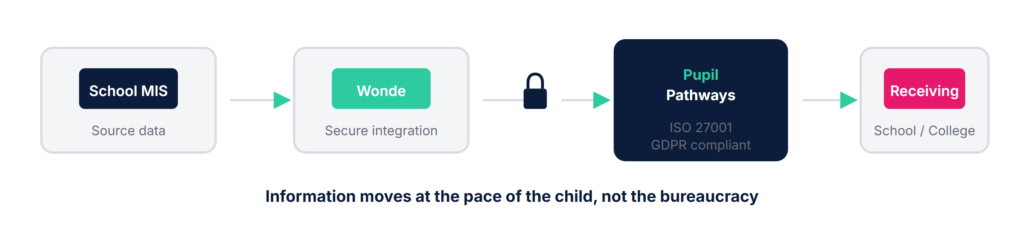
Pupil Pathways delivers a secure, GDPR-compliant, consistent way for schools, local authorities and MATs to share and access comprehensive pupil information. By integrating with school MIS systems through Wonde, schools eliminate the risks associated with spreadsheets, USB drives, or email attachments.
The platform’s audit trails and controlled user permissions ensure sensitive SEND profiles, safeguarding notes, and ISPs can be shared safely without compromising compliance. This directly supports the government’s aim to replace fragmented, inconsistent systems with a unified, protected infrastructure where information moves at the pace of the child, not the bureaucracy.
Whole-Cohort Visibility & Strategic Oversight for LAs and MATs
The SEND reforms emphasise the need for strong system leadership at local authority and trust levels. “Local accountability for every child” must be strengthened through shared responsibility across schools, health, and safeguarding partners.
Pupil Pathways provides the strategic visibility LAs and MATs require. Unlike school-level tools that hold siloed information, Pupil Pathways offers aggregated dashboards showing SEND profiles, levels of need, attendance risk, behaviour trends, safeguarding indicators, and transition readiness across every school in a local area. Local authorities using Foresight can monitor patterns of vulnerable pupils, see where escalations are occurring, and deploy resources accordingly.
Reducing Teacher and SENCO Workload Through Digitisation
- One consistent digital format for transitions
- Automatic integration with MIS data
- Eliminated repeated manual form-filling
- Shared case notes across agencies
- Auto-generated transfer profiles and ISPs
- All documents housed in one secure location
Instead of spending hours manually compiling transfer documents, SENDCOs can focus on what matters most: supporting learners.
Equitable Transitions Across Entire Local Areas
One of the reforms’ most urgent objectives is reducing variation in SEND support between schools and regions. The white paper argues that “partnership has been seen as optional rather than essential,” resulting in inconsistent experiences for children across the country.
Pupil Pathways is explicitly designed for whole-authority or MAT adoption, ensuring that every school, primaries, secondaries, special schools, uses the same transition framework. This prevents SEND support from depending on whether a school uses spreadsheets, informal handovers, or ad-hoc forms. Instead, all children experience the same structured profile, the same expectations, and the same early-information process.
Equity is especially important for white working-class children, persistently disadvantaged pupils, and those with co-occurring vulnerabilities, groups specifically highlighted in the reforms as needing systemic improvement. Pupil Pathways reduces inequity by involving childminders, nurseries, and early years providers (StepIntoSchool) as well as post-16 destinations (NextSteps), delivering equitable, consistent transitions across entire education systems.
Ready to align with the SEND reforms?
Discover how Pupil Pathways can support your local authority, MAT, or school with early identification, ISPs, and inclusive transitions.
Related Resources
SOLUTIONS
Explore our full suite of transition and inclusion tools for schools, LAs, and MATs.
CASE STUDIES
Real-world examples of how LAs have improved transition outcomes with our platform.
GET STARTED
See how Pupil Pathways can support SEND transitions in your local authority or trust.