No Learner Left Behind
How early, secure data sharing at every transition point improves outcomes for every learner
Executive Summary
Pupil Pathways provides digital services that enable the safe, structured and timely sharing of pupil information at key educational transition points. Its suite includes StepIntoSchool (nursery to primary), SixIntoSeven (primary to secondary), NextSteps (secondary to post-16), and Foresight Tracks (supporting early intervention to reduce suspensions).
When information is fragmented, it’s hard to spot who needs help, and harder still to act early. Each service is built on the principle that informed planning, based on rich and contextual data, leads to better learner outcomes, academically, socially and emotionally. A simple preventative approach.
From reducing exclusions, to improving attendance, to strengthening safeguarding, we help educators build the strong foundations every learner needs to succeed.
The Importance of Early Information
Transition is not a moment but a process. Children who are known to their next setting through shared information on needs, strengths, support plans and prior experiences, are more likely to settle quickly, engage in learning, and thrive.
Research shows that delays or gaps in data sharing contribute to disengagement, poor attendance, and long-term negative outcomes. Pupil Pathways facilitates early information transfer so receiving schools can begin planning well before a pupil arrives, particularly for those with SEND, adverse experiences, or complex needs.
Supporting Vulnerable Pupils
Vulnerable pupils, those with special needs, socio-economic disadvantage, or safeguarding concerns are most at risk during transitions. They face greater likelihoods of suspension, absence, and falling behind academically.
Our transition services facilitate the secure transfer of critical documents such as IEPs, EHCPs, pastoral notes for an inclusive transition. This enables the receiving facility to plan ahead to provide personalised support. Spending less time acquiring data frees up more time for implementation and preventative measures.
Creating a Sense of Belonging
Beyond data, transitions are emotional. A consistent theme in the research is that a sense of belonging is a powerful driver of attendance and engagement. When children feel recognised, welcomed and supported from the start, they are more likely to participate positively in their education.
Pupil Pathways supports this by enabling schools to build relationships early with pupils and families before formal learning begins.
In Conclusion: Why Pupil Pathways Helps Ensure No Learner Is Left Behind
Every child deserves a supported start to the next phase on their education journey. Pupil Pathways ensures that key information follows the learner, that transitions are planned not improvised, and that those who need help the most are visible from day one. By supporting professionals to work collaboratively and proactively, Pupil Pathways helps ensure that no learner is overlooked, unsupported, or left behind.
See how Pupil Pathways supports every learner
Book a demo to explore how our platform ensures no learner is left behind at any transition point.
Contents
Foreword

The aim of this paper is to highlight some of the key pieces of research which provide the foundation for the services we offer and the impact it is having on transitions between various phases or education and improvements within schools and local authorities.
After each summary there is a section entitled “Pupil Pathways response”. This outlines how our services are tailored to help our users overcome the highlighted issues. In all cases, it works on the principle that the early and secure sharing of data will improve the chances of pupils enjoying a smoother and inclusive transition.
Today, there is so much data within the education system, yet too often it does not travel, or when it does, it arrives too late for effective action.
Our ambition for this document is to outline what can be achieved through early data transfer and encourage others to take up the challenge. It is, after all, for the benefit of all our learners. Find out how our partners have risen to this challenge in Appendix Two.
With best wishes,
Brendan
School Transition
Smoothing the Nursery to Primary School Transition
The report Birth to 5 Matters: Non-statutory guidance for the Early Years Foundation Stagei, published on behalf of the Early Years Coalition by Early Education is very clear about the importance of the transition into primary schools.
Starting school is a major milestone for any child, with the transition from nursery or pre-school into Reception setting the tone, not just for the first year of formal education, but for a child’s confidence, sense of belonging and long-term learning journey. Yet for too many children, this transition is more stressful than it needs to be because the right information is not being shared early enough, or in the right way.
“Effective transition is a process, not a one-off event.”
Birth to 5 Matters, 2021
We know that effective transition involves coordinated planning, genuine partnership with families and the thoughtful handover of information. Yet as Birth to 5 Matters highlights, some children are especially vulnerable at times of change. These include children who are summer-born or born prematurely, those with SEND, EAL children and those who have faced disruption, loss or instability in early development. Ensuring these children feel safe, understood and valued during transition is not optional, it is essential.
“Moving from feeling known to feeling unknown can raise insecurities about having entitlements and needs met.”
Birth to 5 Matters, 2021
The evidence is clear: when children feel known they are more likely to settle happily and engage with their learning journey. Birth to 5 Matters stresses the importance of maintaining that sense of continuity between home, early years settings and school. Yet this only happens when early years providers and schools share high-quality, detailed information about the child’s experiences, needs, and strengths early enough for schools to plan meaningful support.
A RESPONSE FROM PUPIL PATHWAYS
At Pupil Pathways, this is exactly what StepIntoSchool is designed to support. The platform provides a secure, structured way for nurseries, childminders and schools to work together, sharing key information well before September. This allows Reception teams to plan interventions, tailor their approaches, and make sure every child (especially those most vulnerable at times of change) feels welcome and ready.
“Transitions are opportunities for professional dialogue between settings, as well as with the home.”
StepIntoSchool reflects what Birth to 5 Matters calls for: collaborative working, shared responsibility and a joined-up approach to inclusion. It allows professionals to flag additional needs early, record insights and work together to build strong relationships with children and families. By reducing the administrative burden, it frees up time for visits, conversations and activities that make transitions feel personal and supportive.
Sharing Information Between Nursery and Primary Schools
The report “An evidence-based approach to supporting children in the preschool years” is a collaborative programme of work between Child of the North and the Centre for Young Lives.
In the Foreword, Anne Longfield and Camilla Kingdon consider the impact of Covid-19 on the children arriving or starting their time at primary school, especially those considered vulnerable. Their concerns include:
“Children arriving at Reception wearing nappies, still sitting in buggies, and unable to properly communicate or socialise with other children. Many of these children have developmental problems, struggle with speech and behaviour, and can require significant extra attention and support from already over-stretched school staff”.
Unfortunately, “those who were deemed not school ready were nearly 2.5 times as likely to be persistently absent from school”
School readiness and NEET
The report also notes that these development problems can be long-lasting.
Analyses show that children who are not school ready are around three times as likely to be NEET at 16-17 years. This large body of work demonstrates how preparing children for formal education during the early years (i.e., ensuring they are school ready) is pivotal to later outcomes.
The report team came up with seven principles. They note that their recommendations are pragmatic in nature and recognise that the UK is in a perilous financial state. These recommendations do not pretend there is a magic wand that will immediately fix the system.
One of these principles is Using and sharing information across public service providers effectively.
In it they state that “The efficient transmission of information between preschool settings and schools will stop children falling through the knowledge gaps that currently appear when children transition from one setting to another.”
A RESPONSE FROM PUPIL PATHWAYS
Pupil Pathways is currently working with selected local authorities on StepIntoSchool. This uses the experience of supporting primary to secondary transitions acquired over the last five years and applying it to the move to Reception from nursery schools and other pre-school settings.
The Importance of Primary to Secondary Transition
It has long been recognised that the primary to secondary transition is both a time of concern, and one of opportunity. Children leave their primary school, where they have been known for six or more years and where they enjoy the comfort of a familiar environment, for the challenge of the new: new friends, new subjects, new teachers and new pastoral systems to name but a few.
Most children pass easily through this transition phase, adapting and growing as expected. Some, who perhaps struggled in primary schools, may thrive in the new environment, but others find the process a challenge. This is well documented in both the research and in anecdotal evidence from schools and those who support them. We are all familiar with the KS3 dip in academic performance and downturn in attendance in Y7, and, as has been recently reported, a further dip in Y8.
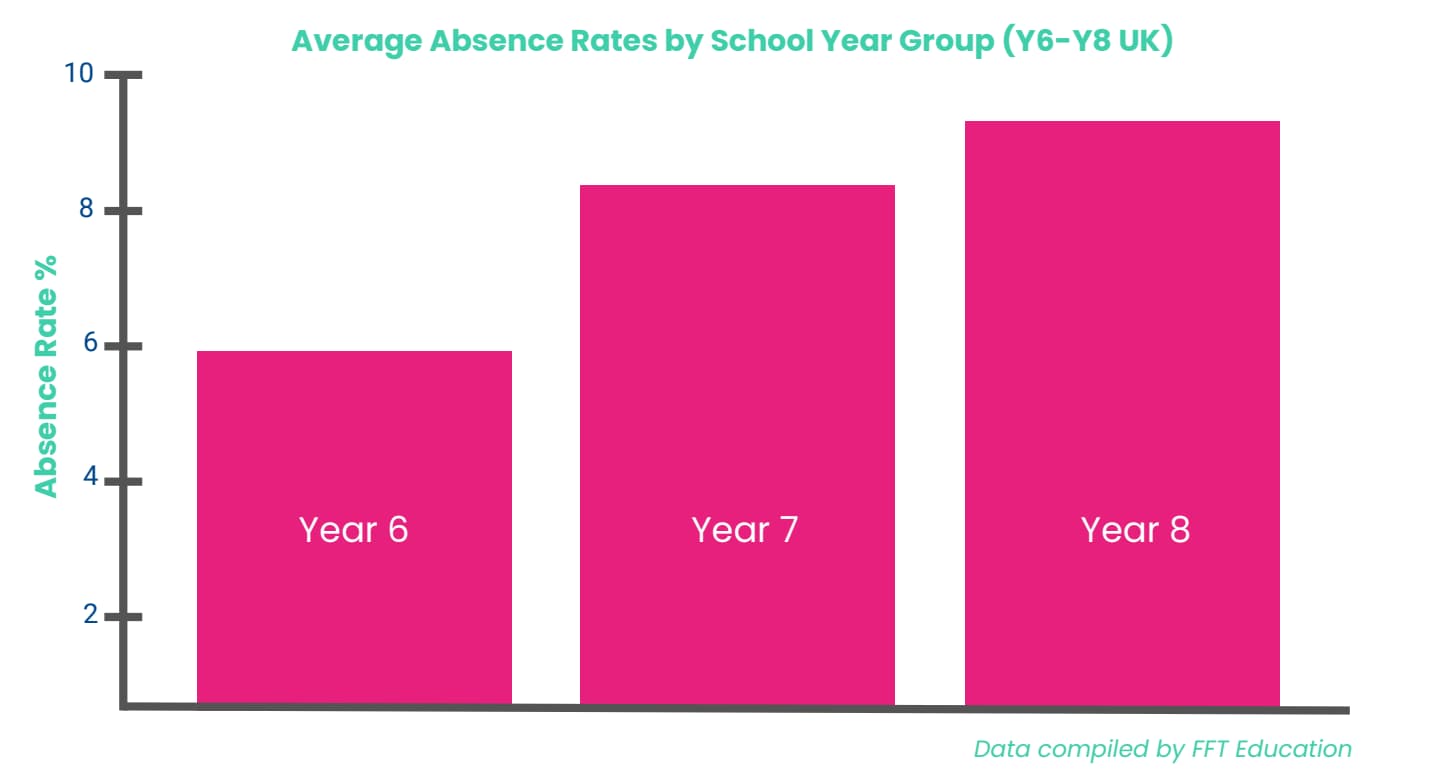
Then there are the children who we know will need detailed individualised planning: those with SEND, those who are looked after, and those who are vulnerable, perhaps with safeguarding issues. Early and detailed information is essential for a successful and inclusive transition. It is this category which is examined first.
Call for Evidence: Inclusion in Practice – Emerging Insightsiii
The team convened by Tom Rees, Chair of the Expert Advisory Group for Inclusion, has produced a report which showcases:
What is already happening in schools to support inclusive practice for children and young people with special educational needs and disabilities (SEND).
These observations are contained within five Insights. This section will focus on Insight 1 – Knowing children well, early and often.
Insight 1: Knowing Children Well, Early and Often
As would be expected, transition is at the heart of this insight. It is a time of change, and in common with most changes, is one of both concern and opportunity.
The report states the:
Importance of planning ahead, meeting families, and sharing insight across phases and settings to strengthen continuity of support.
This was found to be particularly important for those pupils who have specific needs, such as SEND. The interventions taken by schools are most impressive. Actions include:
- Visiting each primary school to review existing support
- Creating small group sessions to meet key adults
- Summer term academic and enrichment activities
- Inviting selected pupils to summer schools
These interventions gave [staff] time to form relationships and begin adapting support. Sometimes this would require multi-agency support.
A RESPONSE FROM PUPIL PATHWAYS
To allow these interventions to happen, the secondary schools need accurate and detailed information about each child, and they need it early. If it arrives late, then there is too little time to intervene before the start of the summer holidays.
At Pupil Pathways, our SixIntoSeven service helps this process in the following ways.
- We work with the schools and local authorities to use staggered transfer deadlines. Those children who are classed as vulnerable have their data uploaded and transferred first.
- The information is transferred in a consistent manner. A typical secondary school will welcome children from 15 or more primary schools, with some receiving from three or four times that number. When this comes through SixIntoSeven, the data is in a standard form, so that needs can be more easily evaluated and scarce support fairly allocated.
- As all the information is in one place, it can be immediately shared with the local authority for more efficient decision-making.
- Virtual schools can access and support their vulnerable cohort so there is continuity of information, reduced risk and structured handover. Please see this case study from the London Borough of Barking and Dagenham.
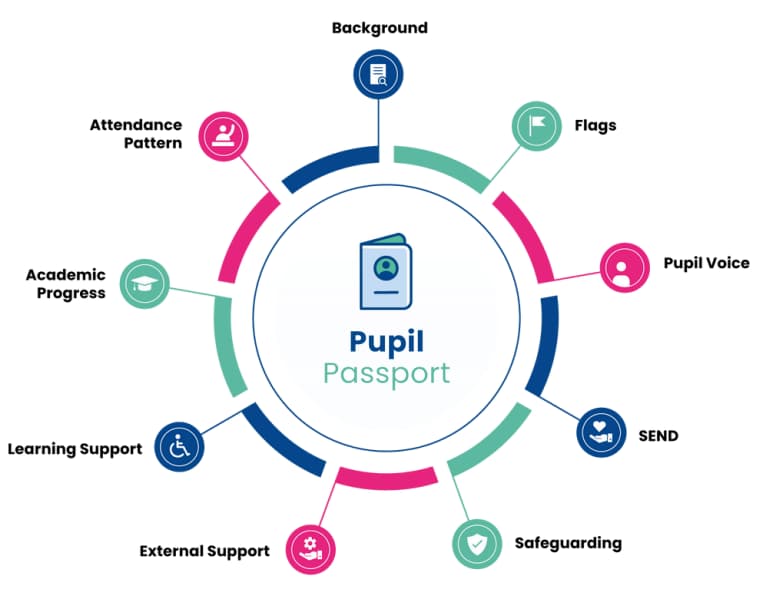
The Pupil Passport
The report mentions that in some schools, the pupils help create their own pupil passports. At Pupil Pathways, we understand the value of such documents as they help pupils navigate journeys between schools and other establishments.
We view the profile in SixIntoSeven as a passport. The information within is the combined knowledge of the staff at the primary school, staff who have looked after the child for six or more years and know the family well. Without this knowledge, it is extremely difficult to maintain continuity of care and progress.
Disadvantaged Children
The disadvantage gap in absence rates around the Year 6 into 7 transition point.
Katie Beynon and Dave Bibby 2024
This study completed by Katie Beynon and Dave Bibby from FFT Education Datalab looks at how rates of absence change over the primary to secondary transition. They look at the percentage of sessions missed in Year 6 and 7 by disadvantage, as measured by free school meal eligibility in the past six years (FSM6).
This was an extensive study. They used data from around 200 000 children attending about 10 000 schools who moved from Year 6 to Year 7 in state-funded mainstream schools between 2022/23 and 2023/24.
In their final summary, they note that
Absence rates among disadvantaged pupils increased by more between Year 6 and Year 7 than absence rates among their non-disadvantaged peers. For the pupils in our sample, the disadvantage gap in absence rates grew from 3.0pp in Year 6 to 4.8pp in Year 7.
This is seen in the diagram below. For Not FSM pupils, there was a 0.2 percentage point increase, whist for FSM pupils, the increase was 2 percentage points.
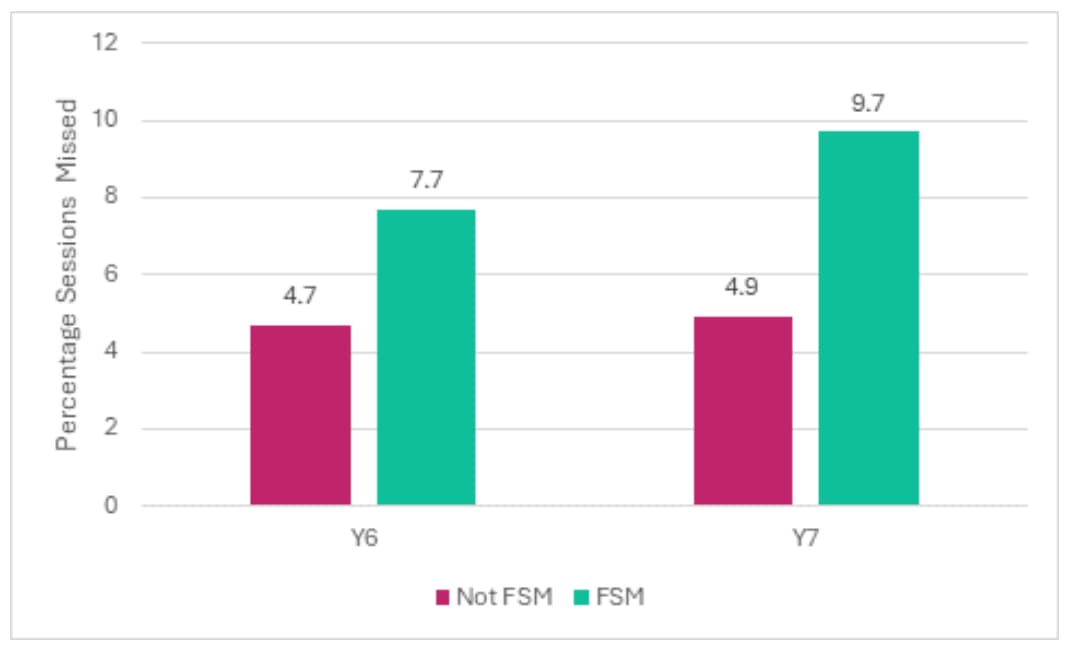
Percentage absence by year and disadvantage – pupils moving from Year 6 into Year 7
Attendance Tracker schools – 2022/23 whole year, 2023/24 Autumn and Spring Terms
(Data taken from Beynon and Bibby (2024))
They also state
The majority, around two-thirds, of the gap in Year 7 was related to pupils having different patterns of absence in Year 6. This underlines the importance of good data sharing practices at transition.
A RESPONSE FROM PUPIL PATHWAYS
In most LAs, the attendance data from primary schools is made available to the secondary school. However, the sheer quantity of data can be overwhelming. We have therefore created a data dashboard which provides an overview of each child’s attendance.
The Transition Watchlist is a further refinement. It highlights to schools and local authorities those pupils whose attendance, based on Y6 data, could become an issue in Y7, and potentially, throughout their time at secondary school. The attendance insights are received as early as Easter, so secondary staff have time to plan and action.
Please visit this blog post to see how Loreto High School in Manchester uses this early information to address attendance issues and put proactive interventions in place.
The Importance of Belonging in Understanding Attendance
The ImpactED report Understanding Attendance (January 2024v) looked at the drivers of pupil absence from over 30,000 young people in England. The authors noted that “School leaders explained to us that many of the strategies they used to manage attendance were no longer as effective after Covid-19” and that
Awareness of sanctions and consequences isn’t strongly linked to improved attendance. Understanding of the importance of school and relationships with peers and teachers were more strongly associated with attendance.
They then identified a number of drivers which have an impact on attendance in English schools. [A] Sense of school belonging is a key driver of attendance across all contexts. This may be particularly important for females and is closely linked with feeling safe at school.
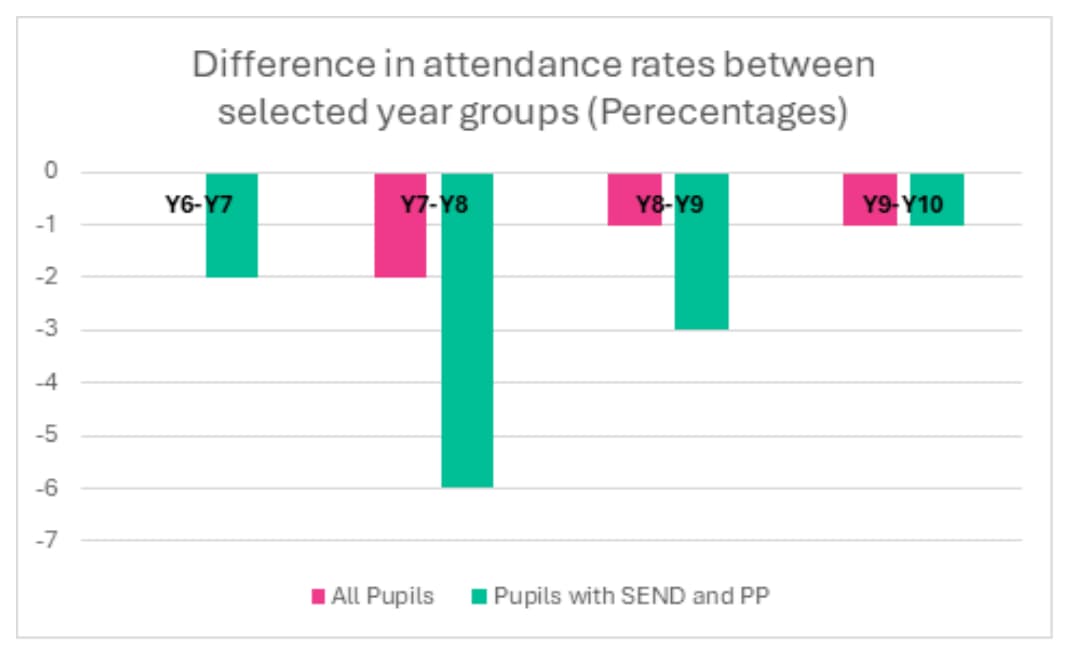
They also highlighted how the challenge of a ‘second transition’ from Year 7 to Year 8 is particularly pronounced for Pupil Premium pupils with SEND. Their figures are illustrated in the graphic below.
A RESPONSE FROM PUPIL PATHWAYS
The sense of belonging is increasingly being seen as critical to understanding good attendance and therefore success in schools.
The Pupil Pathways transition products allow primary schools to transfer early their knowledge of a child and their family, acquired over many years, to the secondary school. They can then develop a more holistic understanding of their new pupil. We see some secondary schools use this time and information to build early links with the child and those that support them. The child realises that, before they put on their new school uniform, they will be met with members of staff they know, and who know and understand the problems the child might be facing.
Early detailed information can never guarantee a smooth and successful transition, but it can increase the probability of it occurring. This is a challenge which has been taken up by Manchester Council. You can read how the early transfer of detailed information can help create a smooth transition through targeted interventions. Read more…
Learner Mobility
One of the issues which faces many transitions managers in local authorities and education establishments is when pupils move from one local authority to another.
Different local authorities as well as schools have their own systems which can cause confusion, duplication, and for some learners to fall through the cracks. Pupil Pathways offer a free lite service available to all non-Pupil Pathway schools.
The lite service can be used by a school sending a pupil to a Pupil Pathway school, or by one which receives from a pupil Pathway School. Read more…
Post-16 Transitions – The Importance of Collaboration
Collaboration lies at the heart of all Pupil Pathways services. Some learners pass along their educational journey in a linear fashion, with minimal support. Others take a more complex path and require the support of a wider range of professionals. This is highlighted in the UK DfE report Case studies on post-16 transition: Best practice examples of transition support for year 11 students in alternative provision (AP)vi published in October 2021.
In the first case study the report notes
The AP setting made sure each learner received the individual, personalised support they needed to successfully access education, training or employment. To do this all relevant stakeholders were involved from the start.
These stakeholders included the local NEET officer (Not in Education, Employment, or Training), who was able to involve the families, the Virtual School Head (VSH) and the other educational establishment where a pupil was dual-registered.
A RESPONSE FROM PUPIL PATHWAYS
Pupil Pathways has a proven track record of bringing together teams to enable informed decision making. Our Foresight Tracks service links together schools, pupil referral units (PRU) and a variety of departments across the London Borough of Barking and Dagenham, including the Virtual School Head (VSH) and the Education Inclusion partners (EIP) to reduce the number of suspensions.
This has been achieved through the automatic raising of flags, data sharing, escalations and the use of structured communication channels between the key stakeholders. Read the full case study.
A Lack of Sharing Disproportionally Affects Learners from Lower Socio-Economic Backgrounds
In April 2025, Ofsted published their report Navigating post-16 careers guidance: supporting learners from lower socioeconomic backgrounds.vii
This focussed on
The quality of careers guidance that students from lower socioeconomic backgrounds receive from further education providers.
The authors noted that
Targeted support was often provided for certain vulnerable and disadvantaged groups, particularly those that had specific funding streams allocated to them, because students in those groups had already been identified.
However,
It was rare for students from lower socioeconomic backgrounds to receive careers guidance that was tailored to their needs. College leaders told us that these students often belonged to other vulnerable and disadvantaged groups and were therefore likely to be receiving additional careers support via those routes. But they felt that information provided by feeder schools about their students when they transitioned to college was often poor, and all the colleges we visited relied on students to declare any additional needs so they could receive targeted support.
A RESPONSE FROM PUPIL PATHWAYS
Pupil Pathways has an established record of vulnerable learners.
For example, when working with local authorities on primary to secondary transition, we encourage the creation of a “Focus Cohort”, to include learners who, for example, are disadvantaged, have SEND or safeguarding needs. The primary school has the most information on these pupils and so it is transferred first to the secondary school for early targeted planning.
Avoiding NEET
The guidance from the Department for Education (DfE) Identify and support young people at risk of being NEETviii, published in 2025, stresses the importance of early interventions to ensure a smooth post-16 transition. Section Five of the report asks
What makes support effective for young people at risk of NEET?
On Page 39 it notes
As part of their statutory duties to ensure that young people can participate, many local authorities play a coordinating role to ensure that at-risk young people and those who are NEET get the support they need. Local authorities can bring together local partners to ensure that the young person’s support plan and pathway can draw on the full range of support and provision available locally. The ‘transition panel’ model is a good example of how local authorities can facilitate this process.
Then on the following page it clarifies the support by adding that
Support should be evidence based i.e. driven by data and evaluation and coproduced with young people.
A RESPONSE FROM PUPIL PATHWAYS
At Pupil Pathways, we believe that all our current services, which help either manage transitions or reduce suspensions and exclusions, can make a contribution to this debate. Indeed, the report An evidence-based approach to supporting children in the preschool years, a collaborative programme of work between Child of the North and the Centre for Young Lives, discussed above, notes that
Analyses show that children who are not school ready are around three times as likely to be NEET at 16-17 years
Many of the reports discussed above have proposed similar solutions: collaboration between settings and institutions and local authorities, the early transfer of relevant data for targeted interventions, all designed to ensure continuity of care and learning. When that happens, learners quickly develop a sense of belonging, which is critical to a successful transition.
Pupil Pathways create the systems which enable this co-ordinated and pro-active approach to become a reality.
Issues with Data Sharing to Support Potential NEETs
An article in FE Week published in April 2025, entitled Our data sharing fears hamper support of NEET young peopleix, outlines how Fear and misunderstanding over GDPR is holding back NEET reduction efforts.
The author, Venugopal Agrawal, a research fellow at Policy Connect agrees that multi-agency collaboration will play a vital role in reducing the number of NEETs. He states that the effectiveness of this is reduced because
Fear of legal consequences discourages organisations from sharing personal data, leading to inefficient service delivery and missed opportunities for targeted intervention.
In addition
Useful data with one organisation remains inaccessible to others
Although he reports that much of this fear is misplaced, he also says that
Many local authorities lack the expertise and infrastructure for secure data-sharing.
His conclusion is that there should be investment
In local authorities’ data capabilities, equipping them with the training and resources needed to manage data securely and effectively. These will be essential first steps towards improving coordination at a local level to address the NEET issue
A RESPONSE FROM PUPIL PATHWAYS
Pupil Pathways is an ISO 27001 (information Security) and GDPR compliant service through which all professionals can safely transfer pupil information. However, as well as providing the IT infrastructure, we also offer a full set of data-sharing agreements so that all users can be confident that when they upload data, they do so within the legal framework.
NextSteps – The New Post-16 Service from Pupil Pathways
NextSteps is the new post-16 service from Pupil Pathways which has been designed to create smooth transitions for learners as they move from KS4 to the next stage of their educational journey. As with StepIntoSchool and SixIntoSeven, it is rooted in the understanding that the transfer of a detailed learner profile will enable the new establishment to plan for individual needs and that this planning will require the informed support of a wider range of professionals.
The Scope of the Service
For NextSteps, the data which can be transferred include:
- Attainment data (e.g., predicted as well as actual GCSE grades)
- Attendance and behaviour records (highlighting patterns or concerns)
- Support needs such as SEND/EHCP, emotional well-being, or medical requirements.
This early flagging allows post-16 institutions to ensure that the right courses have been chosen and that the necessary support can be made available. Once the learner has signed up for the course, the institution will be aware of the learner’s abilities and be able to implement the support plan to help eliminate barriers to a successful start. There are understandable concerns about GDPR which are dealt with below.
A RESPONSE FROM PUPIL PATHWAYS
Pupil Pathways has had experience in the safe transference of huge quantities of information-rich data. In 2025, we supported over 30 000 pupils in the move from primary to secondary school and rolled out successful pilots of our StepIntoSchool service which helps children move from nursery to primary school. In 2026, StepIntoSchool will be fully operational in three local authority areas.
Although each transition point is unique, we have the foundations upon which new services can be created and rolled out for the benefit of a new cohort of learners.
Our Vision
Our philosophy and vision for NextSteps is encapsulated in the report below, published in 2018 by the Welsh Government on the impact of post-16 data sharing.
The report Effective post-16 transitions and data sharing: a short guide for schools and post-16 learningx notes that
Successful learner transitions are proven to dramatically increase retention and progression to further education and training and ultimately sustainable employment.
Where information sharing happens routinely, receiving institutions are able to plan for learners’ continuing education by taking into account their prior attainment, strengths and weaknesses, and support needs. This helps ensure that the learner is enrolled on the right course and receives the necessary support from day one.
Foresight Tracks – Reducing Suspensions, Exclusions and Attendance Concerns
Outcomes for young people who experience multiple suspensions
Allen Joseph and Whitney Crenna-Jennings 2024
The implications for those who do not experience a smooth transition and who end up in a cycle of suspensions was highlighted by Allen Joseph and Whitney Crenna-Jennings in their Education Policy Institute Report Outcomes for young people who experience multiple suspensions (March 2024).
They
Studied a cohort of 585,827 pupils who were registered in a state school in year 7 in 2014, following their time through secondary school until they sat their GCSE exams in 2019.
The authors noted that
Suspended pupils are, on average, not achieving a standard pass in GCSE English and maths. In fact, suspended pupils are, on average, approximately 12 months behind their not-suspended peers.
They do note that
We cannot be sure that the suspension itself causes the difference in GCSE grades. Other unmeasured characteristics could be contributing to the association.
A RESPONSE FROM PUPIL PATHWAYS
Our Foresight Tracks service has been used in the London Borough of Barking and Dagenham (LBBD) to help reduce the number of suspensions and permanent exclusions and those with significant attendance concerns. It does this by allowing for structured collaboration between schools and supporting professionals to create, implement and evaluate the most appropriate interventions for each pupil.
The Costs of Suspensions and Exclusions
Zhang, K., Tawell, A., & Evans-Lacko, S. have attempted to look at The costs of school exclusion: a case study analysis of England, Wales and Scotland. The article covers the well-known costs, such as the yearly rate for alternative provision (AP), and also the administrative and pastoral costs which will not appear in the accounts.
They look at the costs associated with case studies. For example, in Case Study 1:
Student aged 15 years (key stage [KS]4) they consider pre-exclusion, the exclusion process and post-exclusion.
They cost out a headteacher at about £70 per hour. You can then add on time for the Head of Year, the SEN Coordinator and the Safeguarding Lead. It all mounts up.
A RESPONSE FROM PUPIL PATHWAYS
It would never be argued that any product would eliminate suspensions and inclusions. However, we do believe that the relatively small cost of, for example SixIntoSeven, which is usually equivalent to a couple of supply days for a primary school and a few more for a secondary, is preventative money well spent.
Appendix One – The Pupil Pathways Services
Pupil Pathways brings together four powerful solutions, StepIntoSchool, SixIntoSeven, NextSteps and Foresight Tracks, to create one joined-up system that supports every learner, at every stage of their education journey.
StepIntoSchool – A confident start for every learner
StepIntoSchool is designed to support a smooth personalised transition from early years settings into primary school, with a particular focus on children who need additional support. The platform enables nurseries, childminders and schools to collaborate early, sharing consistent and structured information in a secure GDPR-compliant way.
This joined-up approach allows pre-school providers to flag SEND and vulnerable children in advance, giving primary schools the insight they need to plan support and interventions before the September start.
SixIntoSeven: For early information and better outcomes
SixIntoSeven transforms the way schools manage transition between primary and secondary phases, making it earlier, easier and more effective. Instead of last-minute meetings and scattered data, schools can securely share everything secondary teams need to know, making teacher workloads more efficient. From SEND, wellbeing and safeguarding to pupil voice, attendance behaviour and academic progress, it is all there: structured, consistent and ready to use. This results in better planning, stronger connections and a smoother inclusive start for every learner.
NextSteps: Supporting the next step with confidence
Transitions do not stop at secondary school. NextSteps is the newest addition to the Pupil Pathways services, designed to support learners moving from KS4 into college, sixth form or post-16 training, wherever the setting.
With input from teachers, support staff, and wider professionals, it ensures every young person receives the right support, at the right time, for a successful and confident start.
Foresight Tracks: From warning signs to early support
Foresight Tracks help schools and local authorities work together to identify learners who are at risk, reduce suspensions, exclusions and attendance concerns through early insights and joined-up support. It gives teams a shared view of each pupil’s journey, with real-time access to attendance behaviour, intervention and support history. When a school flags a concern, local authority staff can see the full picture, assess needs quickly, and agree on targeted next steps, all within a GDPR-compliant platform. Each implementation is designed to enhance existing processes and make teams more efficient at supporting those at risk.
Appendix Two – Case Studies
Please find below short summaries of our case studies which demonstrate how Pupil Pathways work in partnership with colleagues from all types of education establishments to promote collaboration.
StepIntoSchool
How StepIntoSchool has helped the transition from nursery to primary schools in Tameside
Previously, early years settings used a Microsoft Forms process, but this process was difficult to quality assure. Pupil Pathways resolved this by centralising all data in one place, which created a clear, accountable, and quality-assured process involving the setting, the primary school and the local authority.
Read more…
SixIntoSeven
How SixIntoSeven helped save time, reduce workload, and improve transition outcomes for pupils at Pikes Lane Primary School
“We had 60 children going to 15 different schools. That’s a lot of meetings. And it wasn’t just me. The SENCO and Year 6 teachers were all pulled into those meetings, taking time away from pupils.”
“SixIntoSeven gives us peace of mind. We know the information has gone, it’s been shared securely, and we can focus our time where it matters most.”
Read more…
SixIntoSeven
Getting complete, accurate transition information in time to make a difference – Audenshaw School
In 2021 Audenshaw adopted SixIntoSeven, transforming how pupil data was collected, stored, and shared. With the platform, every piece of key information, from safeguarding and SEND to academic and pastoral insights, was uploaded securely, in one place, and made available only to the right people.
Read more…
SixIntoSeven
Delivering a streamlined, personalised transition with SixIntoSeven at Thornleigh Salesian College
Thornleigh Salesian College in Bolton is typical of many secondary schools as it welcomes students from about 35 associated primary schools.
The use of SixIntoSeven proved very useful for Thornleigh, providing secure, GDPR-compliant and accessible data storage. The data is then presented to the user in a consistent way which is easy to access and navigate. The use of flags, whereby a primary school indicated that an additional conversation was needed, or simply to raise awareness, was valued.
Read more…
SixIntoSeven
A city-wide approach to primary to secondary transitions
In Manchester, the transition from primary to secondary school presents significant challenges, especially for vulnerable pupils. With 187 schools across the city and over 50% of them academies, creating a joined-up approach has been difficult.
Now, SixIntoSeven streamlines data sharing directly from school MIS systems, reducing workload for Year 6 teachers and improving the quality and timely receipt of information secondary schools need to plan and be proactive.
Read more…
Further case studies from across our partners
Lewisham Council
“Transition is one of those major milestones in a child’s life. We asked ourselves, how do we do things better?”
Ruth Griffiths, Head of Access, Inclusion and Participation, at Lewisham Council Education Services.
Read more…
How London Borough of Barking and Dagenham Education Inclusion Team is using Pupil Pathways to achieve their ‘Best Chance in Life’ strategy
The power of using good information to make tangible impact on pupils’ lives and create best practice across the LA
“This is more than just data”
David Botterill, LBBD Exclusion Lead
Read more…
Hounslow Education Partnership (HEP): to deliver transition across schools with improved efficiency and GDPR-compliance, enabling enhanced support for SEND and vulnerable pupils
We’ve learned over the years, the earlier we talk about transition the better, because we can highlight transition needs to all the different users. Cormac Bourne, HEP
Read more…
Bolton: Connected education settings for the most vulnerable children in Bolton
“It’s not working!” Deborah Butler, Transition and Inclusion Lead
lack of consistency, workload and the need for accurate and consistent information transfer between schools to avoid pupils falling through the cracks.
Read more…
London Borough of Barking and Dagenham Ever CIN and vulnerable pupils
I think from an education point of view [tracking only current CIN or CP pupils] is really flawed and I think it doesn’t give the longitudinal care that our young people need when they’ve had a period of chaos. Adela Kay LBBD Virtual School
Read more…
Appendix Three – The Pupil Passport – All Information in One Place
One shared view of every learner built around what matters most.
Created by using our full suite of services, it ensures information is shared securely and meaningfully, supporting connection and continuity at every stage of transition. It is their passport to the future. It is structured, secure, and built for connection, not just compliance.
Background: Context matters, and we ensure you have the full picture. Share information about home life, languages spoken, recent changes or anything else that might shape a learner’s journey and sense of belonging.
Flags: Highlight key indicators quickly and easily, such as SEND, safeguarding concerns, wellbeing or attendance issues.
Pupil Voice: Give learners a voice in their transition.
SEND: Detailed SEND needs, including ECHPs, IEP’s Safeguarding: Key safeguarding information is shared securely and consistently.
Safeguarding: All safeguarding concerns and documents can be securely transferred for early planning.
External Support: Details of any services involved with the pupil, from Early Help to CAMHS.
Learning Support: Insight into what helps each pupil learn best.
Academic Progress: A clear snapshot of each learner’s attainment, progress and potential.
Attendance Behaviour: Patterns and trends of attendance, behaviour, including any interventions in place.
Bibliography
I. Early Education. Birth to 5 Matters: Non-statutory guidance for the Early Years Foundation Stage. Early Years Coalition, 2021.
II. Child of the North & Centre for Young Lives. An Evidence-Based Approach to Supporting Children in the Preschool Years. 2024.
III. Department for Education. Case Studies on Post-16 Transition: Best Practice Examples of Transition Support for Year 11 Students in Alternative Provision (AP). UK Government, October 2021.
IV. Ofsted. Navigating Post-16 Careers Guidance: Supporting Learners from Lower Socioeconomic Backgrounds. April 2025.
V. Department for Education. Identify and Support Young People at Risk of Being NEET. UK Government, 2025.
VI. Agrawal, Venugopal. “Our Data Sharing Fears Hamper Support of NEET Young People.” FE Week, April 2025.
VII. Welsh Government. Effective Post-16 Transitions and Data Sharing: A Short Guide for Schools and Post-16 Learning. 2018.
VIII. Rees, Tom (Chair), Expert Advisory Group for Inclusion. Call for Evidence: Inclusion in Practice – Emerging Insights. 2024.
IX. Beynon, Katie & Bibby, Dave. The Disadvantage Gap in Absence Rates Around the Year 6 into 7 Transition Point. FFT Education Datalab, 2024.
X. ImpactEd. Understanding Attendance. January 2024.
XI. Joseph, Allen & Crenna-Jennings, Whitney. Outcomes for Young People Who Experience Multiple Suspensions. Education Policy Institute, March 2024.
XII. Zhang, K., Tawell, A., & Evans-Lacko, S. The Costs of School Exclusion: A Case Study Analysis of England, Wales and Scotland. 2024.
In Conclusion: Why Pupil Pathways Helps Ensure No Learner Is Left Behind
Every child deserves a supported start to the next phase on their education journey. Pupil Pathways ensures that key information follows the learner, that transitions are planned not improvised, and that those who need help the most are visible from day one. By supporting professionals to work collaboratively and proactively, Pupil Pathways helps ensure that no learner is overlooked, unsupported, or left behind.
Ready to ensure no learner is left behind?
Discover how Pupil Pathways can transform transitions across your schools, local authority or MAT. Book a demo today.
Related Resources
Case Study
How SixIntoSeven is streamlining data sharing across 187 schools
Case Study
Using Foresight Tracks to reduce suspensions and improve outcomes
Whitepaper
How Pupil Pathways aligns with Every Child Achieving and Thriving