The Empty Chair Was Never Sudden
A reflection on absence, the slow drift that precedes it, and why a number rising to 18.1% is really thousands of quiet stories
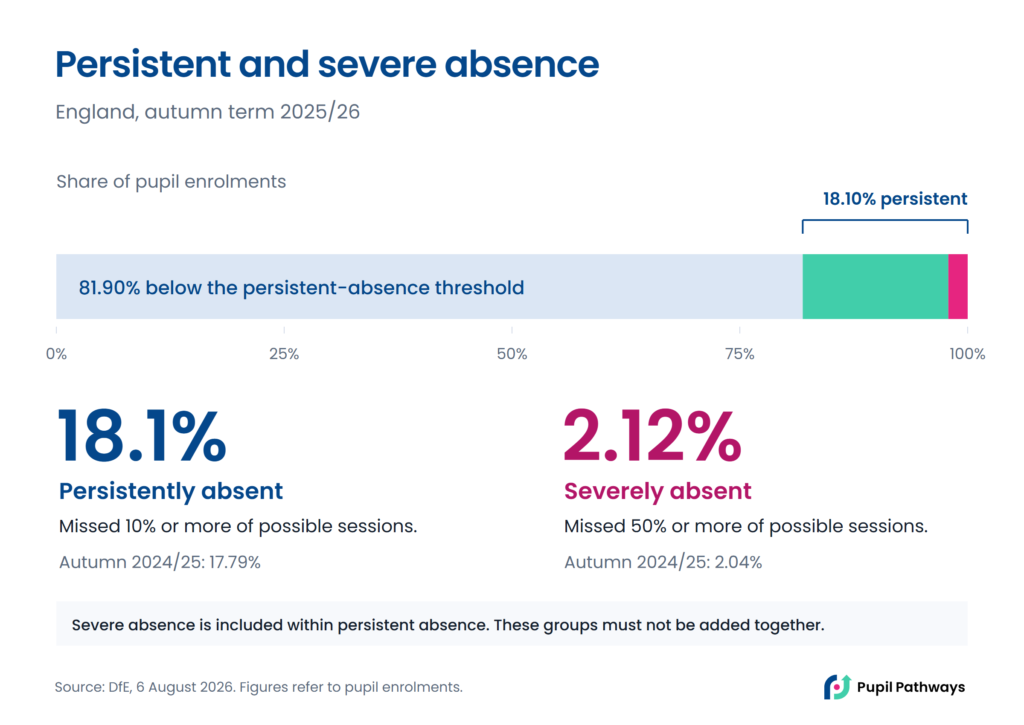
The DfE’s latest absence figures landed this month, and one line has stayed with me. Persistent absence in the autumn term rose to 18.1%, and severe absence to 2.12%. Nearly one in five children now missing at least a tenth of their schooling, and a smaller, more troubling group missing more than half. It is easy to read numbers like these and feel only their scale. What I keep thinking about is their slowness.
Because an empty chair is never sudden. Severe absence, the child who is barely there at all, does not begin as severe. It begins as a Monday here, a Friday there. A morning that becomes an afternoon. A pattern that, viewed one day at a time, never quite looks alarming enough to act on. By the time a pupil crosses the line into the statistics, they have usually been drifting away from us, in full view, for a very long time.
A leading indicator, if we choose to read it
Attendance is often treated as the thing we measure at the end: a number to report, a target to hit. But I have come to see it differently. Attendance is one of the earliest, most honest signals a child gives us that something is wrong. Long before a suspension, before an exclusion, before a young person disappears at transition, the attendance data was already speaking. Quietly, undramatically, but speaking.
We know where this drift tends to lead. The children who become persistently absent are so often the same children standing at the fault lines: moving between phases, carrying an unmet need, already known to be vulnerable. Absence is not merely a problem in itself. It is a leading indicator of exclusion, and of the wider falling away that follows a child for years. The tragedy is not that we cannot see it coming. It is that we usually see it only in hindsight, once the trend has hardened into an outcome.
The difference between counting and noticing
This autumn brings a new regime of attendance targets for every school. I understand the instinct. A shared expectation, a line to aim above. But a target measures where you ended up. It does not, on its own, help you get there. The uncomfortable truth is that you can watch your absence figure with great diligence and still be watching a child leave in slow motion, because the number tells you what has already happened, not what is happening now.
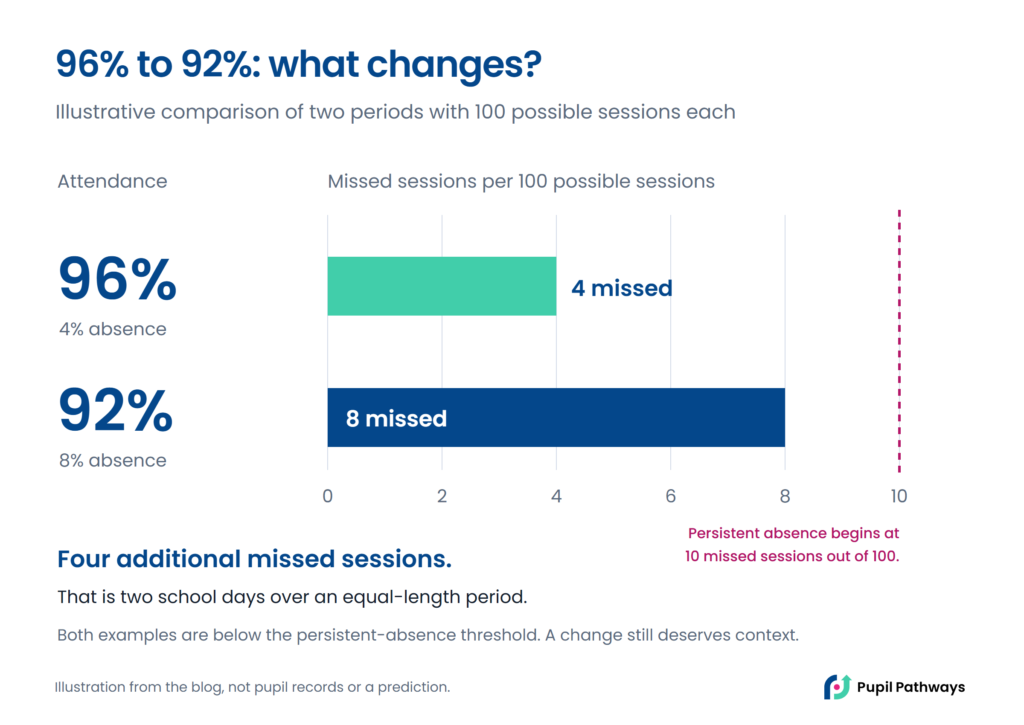
There is a real difference between counting absence and noticing drift. Counting is retrospective: it tallies the days already lost. Noticing is early: it catches the first few missed sessions, sees them alongside a transition, or a SEND flag, or a change in behaviour, and treats that combination as the warning it is. A child sliding from 96% to 92% is not yet a statistic. They are still reachable. Everything depends on whether anyone sees the slide while it is still small enough to reverse.
Getting ahead of the drift
That, for me, is the whole of it. Not chasing the target, but getting ahead of the drift that produces the target. When I think about the work we do at Pupil Pathways, and with Foresight, it grew out of this exact frustration: the wish to band and flag the early signals, to bring attendance together with transition and need into one honest picture, and to surface the child who is beginning to slip while there is still time to knock on a door. But the banding is only a means. The point is the knock on the door.
A school entering the new target regime has a choice about how to hold that pressure. It can wait for the number and hope it lands on the right side of the line. Or it can turn to face the drift early, watch the leading signal rather than the lagging one, and act on the children who are quietly leaving before they have gone. The first is compliance. The second is care. Only one of them actually brings a child back.
Eighteen point one percent is not a statistic. It is thousands of children who were, at some point this term, still just about with us. The question that matters is not how high the number climbs. It is how early we are willing to look.