The Prevention System for SEND Reform
Foreword
From the founder
The UCL evidence is the part of the SEND debate that everyone in the sector knows, and that no system has yet been built around. Children with social care histories. Children with SEND services. The intersection of the two. The exclusion rates are predictable, sustained, and concentrated in the children the system already knows about. The system has the data. It does not yet have the operating model to act on it early enough.
This paper sets out the research case for that operating model, and the Pupil Pathways position alongside it. It is the third in a short series. No Learner Left Behind (October 2025) sets out the evidence for early information at every transition. SEND Reforms 2026: A Response from Pupil Pathways sets out the alignment between our System and the reform direction. This paper anchors the case in the UCL findings, names the system failures those findings expose, and describes the Pupil Pathways response.
The Trailblazer Proposal, the fourth paper in the series, sets out how a 36-month DfE-sponsored programme would validate this approach at scale.
Brendan Nel
Founder and CEO, Pupil Pathways · brendan.nel@pupilpathways.com
Contents
Executive Summary
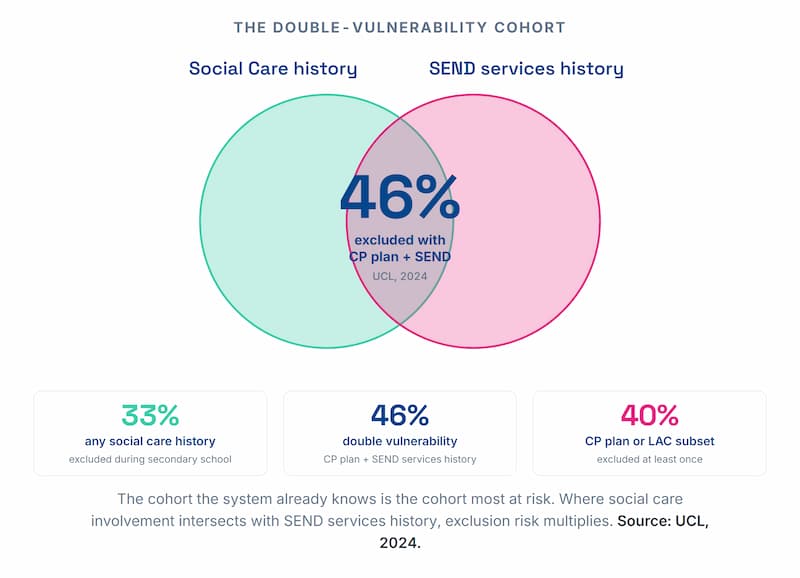
UCL’s 2024 whole-population study reframes exclusion in English secondary schools. Exclusion is not a rare edge case; it is a predictable outcome for children the system already knows. Among children with any social care history in Years 4–6, one in three (33%) is excluded during secondary school. Among children with a Child Protection plan or looked-after status in Years 4–6, around 40% are excluded. Among children with both a CP plan and a history of SEND services, the figure is 46%.
The data exists. The act of converting that data into early, coordinated, multi-agency support is what fails. Three operational failures account for it: known vulnerability is not converted into timely action; transitions accelerate risk because receiving settings lack context; practice is not inspection-proof and creates significant administration workload.
Pupil Pathways is the System for closing those failures. Four modules (StepIntoSchool, SixIntoSeven, NextSteps, Foresight) deliver early information across every transition. A single Pupil Passport carries each child’s needs, context, and interventions with them. Foresight provides the multi-agency case-flow infrastructure that turns, “we know this child” into “we acted in time”.
This paper makes the research-led case for the System and signposts the Trailblazer Proposal as the next step.
The three UCL exclusion rates that drive this paper.
33%
Excluded in secondary school — children with any social care history in Years 4–6 (UCL, 2024)
40%
Excluded at least once — children with a Child Protection plan or looked-after status in Years 4–6 (UCL, 2024)
46%
Excluded with double vulnerability — both a CP plan and a history of SEND services (UCL, 2024)
The research case
Exclusion is concentrated in vulnerable cohorts
UCL’s 2024 study (Risk of school exclusion among adolescents receiving social care or special educational needs services: a whole-population administrative data cohort study) analysed linked national records across social care, SEND and exclusion.
The headline findings:
- 33% of children with any social care history in Years 4–6 were excluded during secondary school.
- Around 40% of children with a Child Protection plan, or who were looked-after in Years 4–6, were excluded at least once.
These cohorts are not anonymous. The Local Authority and the receiving secondary already hold the data. Exclusion is the predictable outcome of late or fragmented action on information that is, in principle, already available.
The three-year LBBD evidence supports the inverse and provides the impact evidence: where a Local Authority operates a structured, school-led, multi-agency case-flow, that predictability can be broken. LBBD’s 95% twelve-week AP reintegration rate, and CWSW cohort exclusion rates below national averages.
Double vulnerability multiplies risk
Where children have both social care involvement and SEND services history, exclusion risk rises again. UCL reports 46% for pupils with both a Child Protection plan and a history of SEND services.
The double-vulnerability cohort: 46% exclusion rate at the intersection of social care and SEND services (UCL, 2024).
This finding has a direct operational implication: separate SEND, safeguarding and behaviour processes operating in silos cannot meet the need of the double-vulnerability cohort. The Local Authority Inclusion Team, the school SENDCO, the DSL, the social worker, the Virtual School and Education Inclusion Partners need one shared case record and one operating rhythm. Foresight is the digital infrastructure for that.
Variation between Local Authorities shows the system is malleable
UCL also reports substantial variation across Local Authorities. The implication is that practice and system design matter. If outcomes vary by area, then Local Authorities can legitimately invest in consistent, authority-wide workflows and data standards to reduce postcode-based variation in thresholds, escalation, and the quality of transition.
This sits directly with the SEND Reform commitment to National Inclusion Standards by 2028. Standards reduce variation only if there is an operating model behind them. Pupil Pathways is that operating model.
The research likely understates the scale
UCL’s authors are explicit about the limitations of their analysis. It includes only children recorded as receiving social care or SEND provision; some children who need help do not access it. It excludes illegal exclusions and off-rolling.

The real-world problem is bigger than the data shows. This strengthens the case for a System that surfaces hidden risk early, before formal thresholds are reached, and that creates an audit trail that withstands scrutiny where practice is challenged.
Inclusion policy and trauma-aware practice cannot work without infrastructure
UCL’s authors call for inclusion-aware policy backed by adequate resources and trauma-aware practice. They warn that zero-tolerance behaviour policies can escalate minor incidents into exclusion, especially for children affected by trauma.
Inclusion policy works at scale only when it is wired into the day-to-day operating system of a Local Authority and its schools. That requires:
- Early warning signs and context captured in a consistent format
- Support coordinated across professionals from a shared record
- Decisions and interventions evidenced with an audit trail
That is the operational gap that Pupil Pathways is built to close.
The system failures the research exposes
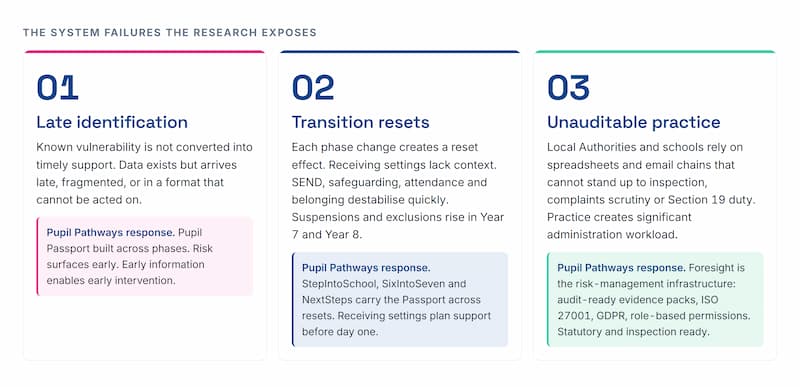
Late identification, transition resets, unauditable practice — and the Pupil Pathways response to each.
Three infrastructure problems. Not training problems, not willingness problems.
The research and Pupil Pathways’ three years of LBBD delivery point to three system failures that drive exclusion risk:
- Late identification. Known vulnerability is not converted into timely support. The data exists but arrives late, in a format that cannot be acted on, or to people who cannot act on it.
- Transition resets. Each phase change creates a reset effect. Receiving settings lack context. Safeguarding, SEND, attendance and belonging destabilise quickly in the weeks following the move; risk of disengagement rises.
- Unauditable practice. Local Authorities and schools are expected to evidence statutory oversight, defensible decision-making, rationale, and compliance with new legislation. Many still rely on spreadsheets and email chains that cannot stand up to inspection or complaints scrutiny.
These are infrastructure problems, not training or willingness problems. A preventative system has to address all three.
The Pupil Pathways response
The System, not the platform
The System, the four transition modules, the inclusion case-flow, and the Pupil Passport.
Pupil Pathways is the System through which a Local Authority operationalises SEND Reform priorities. It is digital infrastructure, not a tool. It includes the data spine, the case-flow workflows, the multi-agency operating model, and the audit and governance evidence that statutory inspection requires.
Foresight: structured prevention, not management of exclusion
Foresight case-flow: school-led graduated response, escalated to LA panel, joined by multi-agency partners, evidenced with an audit trail.
Foresight is designed around governance, risk management, and compliance. It provides:
Governance. Cross-authority visibility, structured decision-making, dashboards for senior leaders, evidence packs and audit trails for panel and Ofsted scrutiny.
Risk management. Early identification with risk scoring and real-time alerts. Issues surface before crisis-led escalation. Schools start the case, follow a graduated model of: Assess-Plan-Do-Review, and escalate to the Local Authority panel where needed.
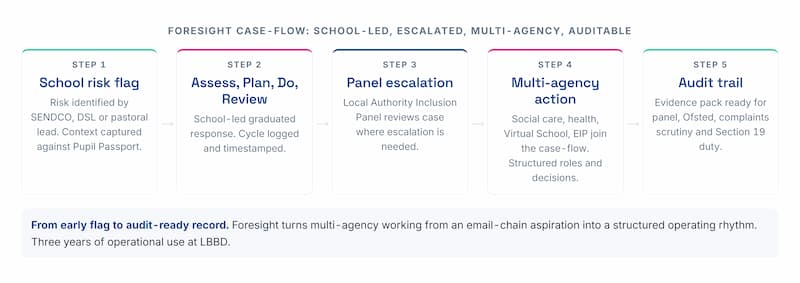
Compliance. Legislation-ready and audit-ready, including Section 19 duties, KCSIE alignment, GDPR compliance, and ISO 27001 certified infrastructure. Foresight is the operational answer to the UCL findings and to the SEND Reform commitment to multi-agency Experts at Hand coordination.
The transition modules
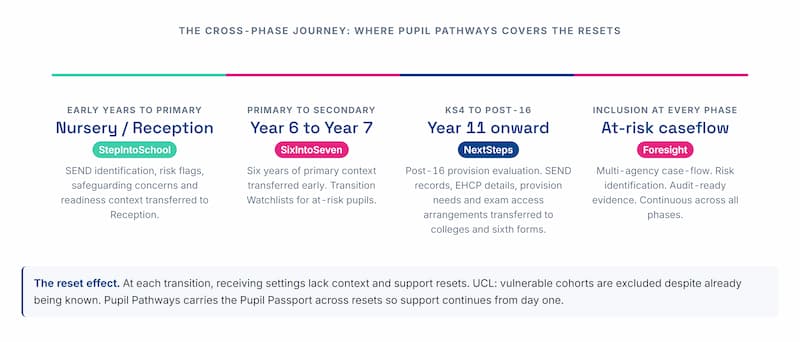
The cross-phase journey: where Pupil Pathways covers the resets from Early Years to Post-16.
Each module is built around the same principle: early information enables early intervention. The Pupil Passport is the structured contextual record that travels with the child.
| Phase | Module | What it does |
|---|---|---|
| Early Years to Primary | StepIntoSchool | Transfers SEND identification, risk flags, safeguarding concerns, family voice and readiness context to Reception. Receiving primaries plan support and targeted interventions before day one. |
| Primary to Secondary | SixIntoSeven | Moves six or more years of primary context into receiving secondaries early. Transition Watchlists surface children with multiple risk factors. Attendance patterns transfer with the child so the Y7 and Y8 risk dips can be planned for. |
| KS4 to Post-16 | NextSteps | Moves SEND records, EHCP details, ISP data, provision needs, exam access arrangements and attendance risk to FE colleges and sixth forms before enrolment. Prevents the post-16 reset risk that drives NEET. |
The Pupil Passport as ISP-equivalent
The Pupil Passport is a digital profile that captures background, risk flags, pupil voice, SEND need, SEND support plans, safeguarding concerns, learning support, external services, academic progress and attendance patterns. It builds a chronology across all phases and follows the child.
For ISP delivery, the Pupil Passport is the data foundation and proven delivery mechanism. An ISP can be assembled from the Passport without rewriting; updated collaboratively with parents, schools, health services and the Local Authority; and carried forward at every transition point while at or a new setting.
The LBBD existence proof
Pupil Pathways has given LBBD the structure and consistency their teams and schools needed to share pupil information in a streamlined, secure way. This has changed how the Inclusion Team works, freeing up time previously spent wrangling spreadsheets to focus on strategic, high-impact interventions.
LBBD Inclusion Team
The LBBD evidence:
- 95% twelve-week AP reintegration for pupils placed in Alternative Provision.
- CWSW cohort exclusions and suspensions below national averages.
- Multi-agency case-flow running across schools, Inclusion Team, Virtual School, EIP, social care and health.
- School-led graduated response with clear escalation pathways to multi-agency panels and appropriate provision.
- Inclusion Team workload reduced, with time redirected into strategic case work, early conversations with schools, families and case workers.
Alignment to SEND Reform 2026
Early identification
Eight reform commitments. Eight points of alignment.
The reform programme places early identification at the centre. The Pupil Pathways transition modules ensure risk and SEND indicators, attendance patterns, safeguarding concerns, learning needs and prior interventions are transferred months before a pupil starts a new phase. Receiving settings can plan support before challenges escalate.
This converts the UCL evidence into action: cohort-level risk is known early (in Years 4–6 for the secondary cohort), so prevention depends on converting known risk into early support, not on waiting for behaviour and attendance breakdown in Y7 and Y8.
National Inclusion Standards by 2028
The Standards aim to remove postcode-based variation by defining what high-quality identification and support looks like in every school. Pupil Pathways supports this by providing structured digital infrastructure and consistent information formats (the Pupil Passport) across settings. This enables MATs and Local Authorities to build coherent cohort visibility and implement Standards consistently.
Individual Support Plans
SEND Reform makes ISPs statutory for pupils receiving targeted and specialist support. The ISP is intended to capture day-to-day provision and be portable across phases. Pupil Pathways is the mechanism to deliver ISP consistency and portability by building ISPs in the setting or directly from the structured data already held in the Pupil Passport: needs, interventions, attendance, safeguarding, pupil voice and parental input. This prevents the portability collapse that occurs at transition points where every school uses different formats.
Multi-agency coordination
The Experts at Hand approach proposed in the Reform programme requires a shared digital environment for professionals to collaborate, share assessments, record interventions and review progress.

Foresight is exactly that safe and secure environment. Multi-agency working becomes an operational workflow rather than an email-chain aspiration.
Attendance and engagement as early warning
Attendance is a national priority and an early indicator of unmet need. Foresight identifies dropping attendance and persistent-absence risk, with multidisciplinary review cycles for the focus cohort. The transition modules ensure attendance patterns transfer early into receiving phases so interventions can be planned before deterioration.
Strengthen inclusive mainstream capacity
Pupil Pathways prevents the reset effect at transitions or risk of exclusion. Early transfer of SEND profiles, prior interventions, risk indicators, attendance patterns, safeguarding notes and pupil voice means support continues from day one. At risk pupils are identified early and risk and provision provided through a structured graduated multi-disciplinary team. The Pupil Passport delivers structured phase-to-phase continuity from Early Years to Post-16.
Data-driven accountability and whole-cohort oversight
SEND Reform delivery depends on accurate, high-quality data. Pupil Pathways is the infrastructure that prevents data loss at key points of change, enabling evidence-led decisions and aggregated insights for Local Authorities, MATs and schools. Foresight produces audit-ready reporting, structured workflow and evidence packs, with role-based permissions and compliance alignment, supporting statutory guidelines and inspection expectations.
Reduce workload and improve consistency of practice
Workload reduction is urgent. Pupil Pathways reduces duplication through consistent digital formats, MIS integration via Wonde, shared notes, and auto-generated transfer profiles including ISPs. SENDCOs and Inclusion teams spend more time on value-add work and less on paperwork and administration.
Impact measures
What we measure across Pupil Pathways deployments.
| Cohort visibility | Percentage of CIN, CP, LAC, Ever-CIN and SEND pupils with an up-to-date Pupil Passport, including context such as suspensions or exclusions and attendance patterns. Identification of destination schools and SENDCOs across the local area and beyond for audit-ready handover. |
| Risk flags | Pupil flags raised early during transition, alerting receiving professionals. KCSIE-aligned prompts for professional inquisitiveness. |
| Early action | Time from first warning sign (attendance drop, behaviour change) to recorded intervention plan and reintegration targets. Handover of children identified as CME, EHE or at risk of exclusion. |
| Transition readiness | Percentage of receiving settings with complete early safeguarding and SEND context before start date. LA and school leader escalation, notification and quality assurance. |
| Exclusion outcomes | Suspensions and exclusions for high-risk cohorts; attendance monitoring; reintegration timelines tracked and monitored. |
| Governance | Completeness of audit trails and evidence packs for panel, Ofsted and complaints procedures. |
Read also
This paper is Paper 3 in the Pupil Pathways position series. Read alongside:
PAPER 1
No Learner Left Behind (October 2025). The research-led case for early information transfer at every transition: Early Years to Primary, Primary to Secondary, KS4 to Post-16, and the role of Foresight in reducing suspensions and exclusions.
PAPER 2
SEND Reforms 2026: A Response from Pupil Pathways. How Pupil Pathways aligns with Every Child Achieving and Thriving and SEND Reform: Putting Children and Young People First. Maps each reform priority to the relevant module.
Appendices
Appendix A · Bibliography
- UCL. Risk of school exclusion among adolescents receiving social care or special educational needs services: A whole-population administrative data cohort study. 2024. sciencedirect.com/science/article/pii/S0145213423003137
- Department for Education. Every Child Achieving and Thriving. 2026.
- Department for Education. SEND Reform: Putting Children and Young People First. 2026.
- Pupil Pathways. No Learner Left Behind. October 2025.
- Pupil Pathways. SEND Reforms 2026: A Response from Pupil Pathways. 2026.
- Pupil Pathways. Trailblazer Proposal. 2026.
Appendix B · About Pupil Pathways
Pupil Pathways is the digital System through which Local Authorities, MATs and schools operationalise SEND Reform priorities. Four modules (StepIntoSchool, SixIntoSeven, NextSteps, Foresight) cover every transition from Early Years to Post-16 and the inclusion case-flow that runs alongside them. One Pupil Passport carries each child’s needs, context and interventions across phases.
The System is in use at the London Borough of Barking & Dagenham and at customer Local Authorities including Lewisham, Manchester, Tameside, Hounslow and Bolton. Pupil Pathways is a Crown Commercial Services supplier, ISO 27001 certified, Cyber Essentials accredited, BESA member, and integrated with school MIS via Wonde.
For further discussion: www.pupilpathways.com · hello@pupilpathways.com · 0333 880 4470
Pupil Pathways · Crown Commercial Services supplier · ISO 27001 · Cyber Essentials · BESA member