How Manchester City Council supports a stronger start to secondary school
Manchester City Council recognised that the transition from primary to secondary school had long been a point of vulnerability for pupils. Keith Bardsley, Senior School Quality Assurance Officer, described the system prior to SixIntoSeven as “quite a fractured and disparate system, of schools doing different things, asking different questions.” The complexity was intensified by the variety of school types operating across the city, including maintained schools, academies and multi-academy trusts.
Continuity of support for pupils with additional needs
The differences between primary and secondary education are particularly significant for pupils with special educational needs. Primary schools tend to know pupils extremely well, often with strong pastoral relationships and relatively high levels of adult support.

In contrast, secondary schools operate on a larger scale, where, as Keith explains, “primary schools often have a similar number of teaching assistants to a secondary school, but the secondary has two and a half to three times the number of children.”
Pupils move from a single-class teacher model to multiple subject specialists, creating what he calls “a different diet, a different offer.” For children with additional needs, this shift can feel abrupt, making continuity of support and understanding harder to maintain without effective information transfer.
Manageable for staff, meaningful for children
Central to the development of SixIntoSeven is the guiding principle articulated by Keith: “manageable for staff, but meaningful for children”, highlighting the need to focus only on what truly matters.
For staff, this means reducing duplication and unnecessary workload, ensuring systems are efficient and practical.
For children, it means that every piece of shared information must contribute to better outcomes, stronger relationships and improved wellbeing. The emphasis is on purposeful data that enables teachers to understand pupils as individuals, ensuring that transition is not just administratively smooth, but educationally and emotionally supportive.
A consistent approach to information sharing
SixIntoSeven enables Manchester City Council to achieve this ambition by streamlining and standardising the transfer of information between schools. The platform provides “timely, succinct data that is usable and useful,” removing the need for multiple spreadsheets and significantly reducing workload.
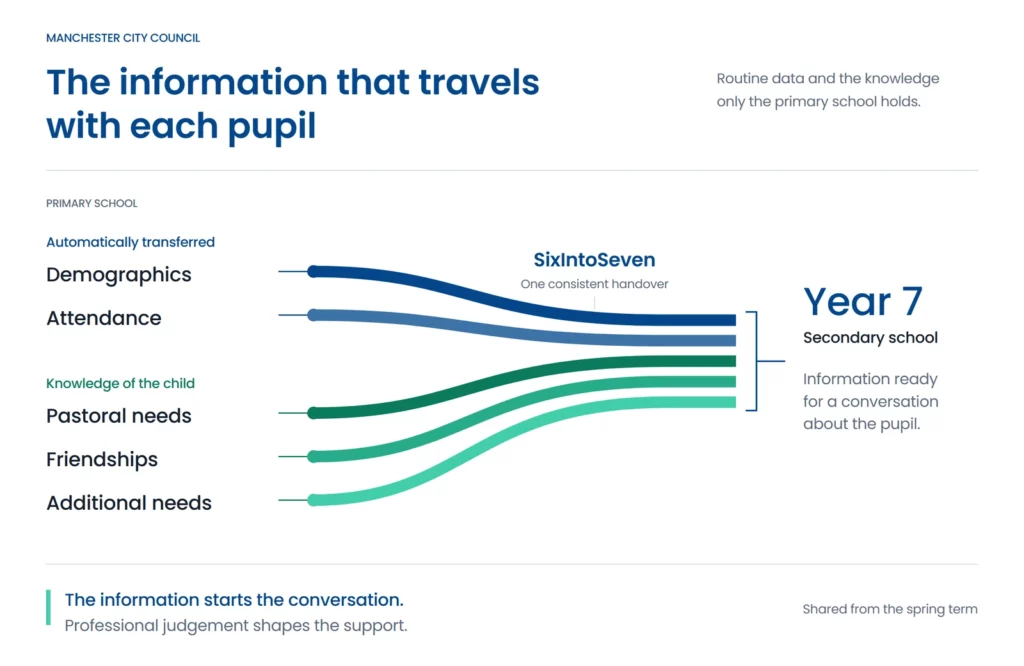
Automated data transfer
Automated transfer of demographic and attendance data ensures that essential information is immediately available, freeing staff to focus on the pupils who need additional support.
Planning from the spring term
Importantly, the system opens earlier in the year, meaning pupils are “through the door, virtually, in that spring term,” allowing secondary schools to begin planning well in advance.
The platform also enables primary schools to share insights that only they hold, such as pastoral needs or friendship considerations, creating “the starting point for a conversation, a dialogue.”
Supporting professional judgement
Rather than replacing professional judgement, SixIntoSeven enhances it by ensuring that critical information is available at the right time.
At a strategic level, the local authority can analyse patterns across the city, supporting schools to act proactively; as Keith puts it, if “there’s an iceberg on the horizon, steer away from it.” This coordinated, city-wide approach ensures consistency, reduces inefficiencies and strengthens collaboration, all focused on improving outcomes for Manchester’s children.
Attendance and early intervention
Attendance is a central priority for Manchester City Council because of its direct link to outcomes. Keith is clear that “children being present is key,” emphasising that learning, engagement and achievement all depend on pupils being in school. Strong attendance at the point of transition is particularly critical in setting long-term patterns.
Using Year 6 data to support Year 7 attendance
SixIntoSeven supports improved Year 7 attendance by enabling early identification of risk. By providing secondary schools with detailed Year 6 attendance data, it allows them to analyse patterns and intervene before issues escalate.
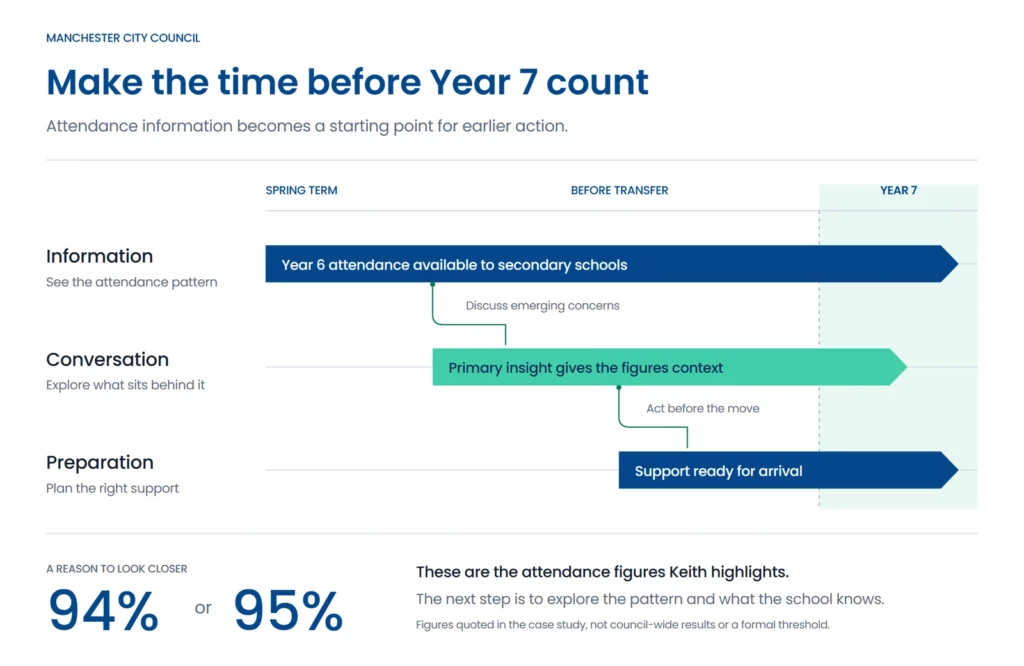
Keith highlights the importance of examining pupils with attendance around “94, 95%,” recognising that these seemingly average figures may indicate emerging concerns.
The system also allows the local authority to model expected outcomes and challenge schools to act.
This proactive approach has delivered measurable impact, with Year 7 attendance becoming “the highest across all year groups” in a recent term. By focusing on early intervention and informed planning, schools can establish strong attendance habits from the outset of secondary education.
Reducing exclusions and suspensions
SixIntoSeven also contributes to reductions in exclusions and suspensions by supporting early, targeted intervention. Access to detailed information enables schools to anticipate pupil needs and respond proactively, rather than reacting to behaviour issues after they arise.

This approach has contributed to “a significant drop in permanent exclusions and suspensions,” demonstrating the value of better-informed transition planning.
Secure and consistent information sharing
Finally, the platform addresses previous concerns around data protection by providing a secure, standardised approach to information sharing. Where schools previously relied on informal methods that created “nerves around GDPR,” SixIntoSeven ensures that data is transferred safely, consistently and appropriately. This not only builds confidence among schools but also ensures compliance with data protection requirements across the system.